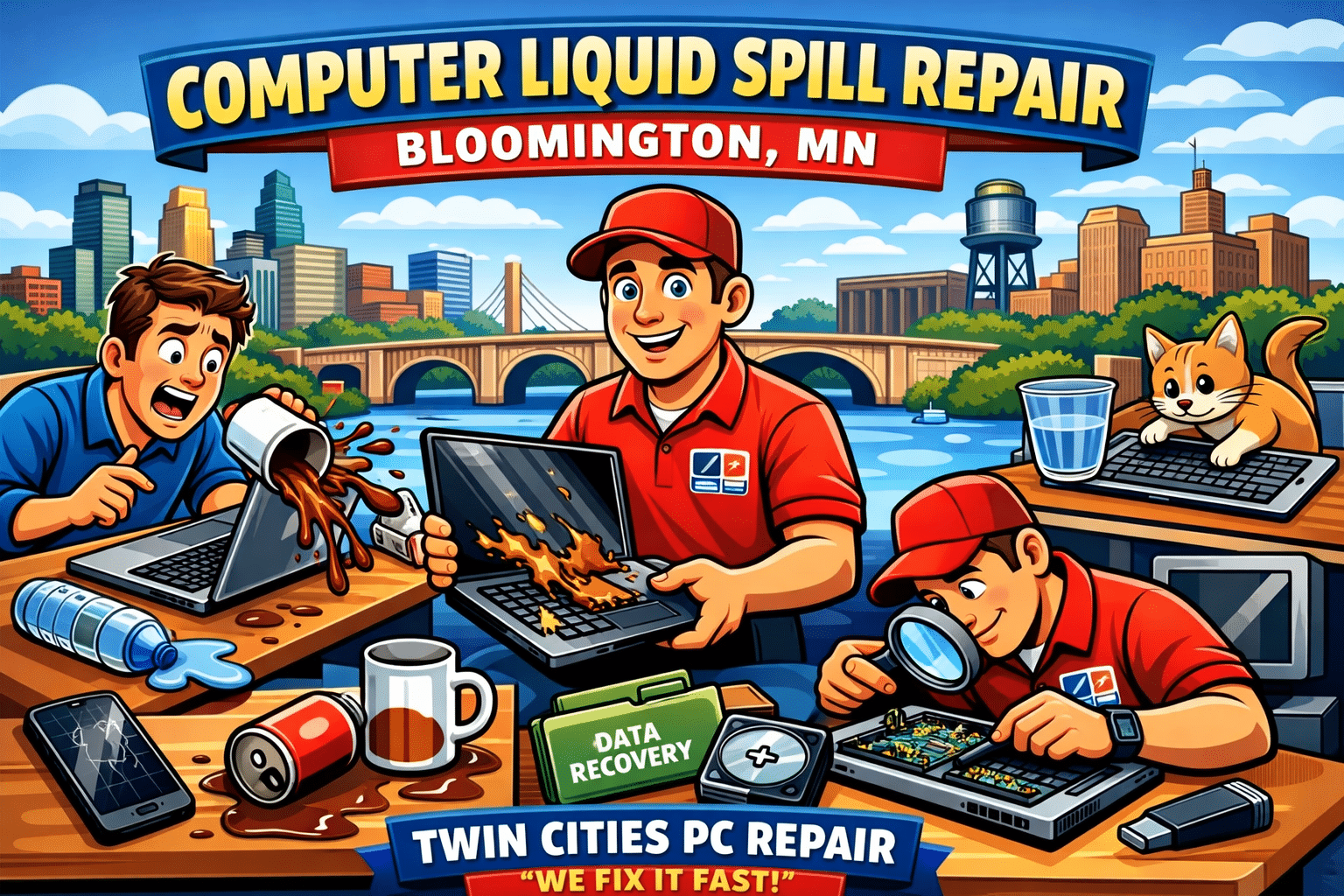
Computer Liquid Spills: What to Do Immediately (and How Twin Cities PC Repair Can Help) – 2/5/2026
Few things are more panic-inducing than watching coffee, water, or soda spill across your laptop or desktop keyboard. In homes and offices throughout Bloomington, Minneapolis, St. Paul, and the surrounding Twin Cities metro, liquid spills are one of the most common—and potentially destructive—computer accidents we see. The good news? A spill doesn’t always mean your computer is permanently damaged, especially if you act quickly and bring it to a trusted local repair shop.
Why Liquid Spills Are So Dangerous for Computers
Modern computers are packed with delicate components, tight circuitry, and high-density boards. When liquid enters a device, it can cause:
Immediate short circuits
Corrosion of internal components
Sticky residue that interferes with keys and connectors
Long-term damage that worsens over time
Even plain water can corrode internal parts if it isn’t properly cleaned and dried. Sugary drinks, coffee, alcohol, or energy drinks are even more damaging because they leave behind residue that continues to eat away at components long after the spill occurs.
What to Do Immediately After a Computer Liquid Spill
If you spill liquid on your computer, time is critical. Follow these steps right away:
Power it off immediately – Don’t try to save files or shut down normally.
Unplug everything – Charger, USB devices, external monitors, and accessories.
Turn the device upside down – This helps prevent liquid from spreading deeper inside.
Do NOT use a hair dryer or heat gun – Heat can warp components and lock in corrosion.
Do NOT turn it back on “to test it” – This is one of the most common causes of permanent damage.
Bring it to a professional repair shop as soon as possible
Many computers that “seem fine” after a spill develop problems days or weeks later due to unseen corrosion. Early professional cleaning can make the difference between a repair and a full replacement.
Why DIY Fixes Often Make Things Worse
It’s tempting to search YouTube for a quick fix, but liquid damage is one area where DIY repairs frequently backfire. Opening modern laptops without proper tools can damage connectors, and surface drying does nothing to remove corrosion under chips, keyboards, or ports.
We often see Twin Cities customers come in after attempting a DIY fix, only to find the damage spread further because the device was powered on too soon.
How Twin Cities PC Repair Can Help
At Twin Cities PC Repair, liquid spill cleanup and recovery is something we handle regularly for residential and small business customers across Bloomington, Minneapolis, St. Paul, and nearby suburbs.
Our professional liquid damage service includes:
Safe disassembly of laptops and desktops
Ultrasonic or manual board cleaning (when applicable)
Removal of corrosive residue
Component-level inspection
Keyboard, battery, or port replacement if needed
Honest assessment if a device is not cost-effective to repair
We work on Windows laptops, desktops, gaming PCs, and many Apple systems, and we always explain your options clearly—no pressure, no guesswork.
Common Liquid Spill Scenarios We See Locally
Coffee spills during work-from-home days
Water bottles leaking in backpacks
Kids knocking over juice or milk
Pets causing desk accidents
Beer or soda spills during gaming sessions
Snow or rain moisture from winter commutes in Minnesota
If it’s happened in the Twin Cities, we’ve probably seen it—and fixed it.
Is Data Recovery Possible After a Spill?
In many cases, yes. Even if a computer won’t power on, the internal storage device may still be recoverable. Twin Cities PC Repair can evaluate your system and determine whether files, photos, and documents can be safely recovered or transferred to a new computer.
Local, Trusted Computer Repair You Can Count On
When a liquid spill happens, working with a local Twin Cities repair shop matters. You get faster service, honest answers, and someone who understands the urgency of getting your computer back up and running.
If you’re in Bloomington, Minneapolis, St. Paul, Richfield, Edina, or surrounding areas, Twin Cities PC Repair is here to help with fast diagnostics and professional spill recovery.
Don’t Wait—Liquid Damage Gets Worse Over Time
If your computer has suffered a liquid spill—even days ago—don’t wait for it to fail completely. Early intervention can save you hundreds of dollars and prevent data loss.
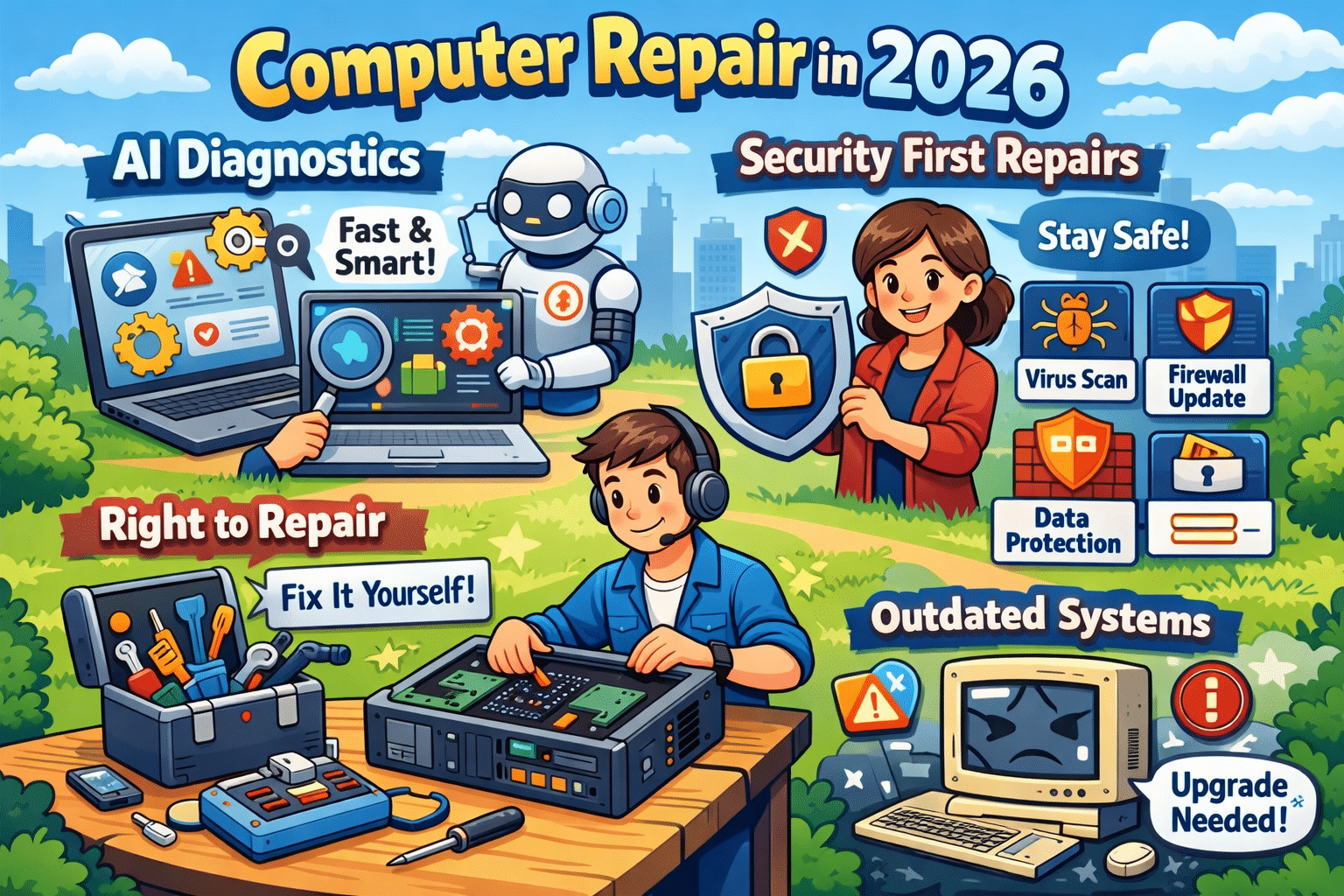
Why AI-Powered Diagnostics and Security-First Repairs Are the Future of Computer Repair in 2026 – 2/2/2026
Computer repair has changed dramatically over the last few years. In 2026, fixing a slow or malfunctioning computer isn’t just about swapping parts or reinstalling Windows. Two major trends now shape the industry: AI-powered diagnostics and a security-first repair approach. Together, they’re transforming how problems are found, fixed, and prevented.
Whether you’re a business owner, remote worker, or home user, understanding these changes can help you make smarter decisions about maintaining and protecting your computer.
AI-Powered Diagnostics: Faster and More Accurate Repairs
Traditional computer troubleshooting relies heavily on manual testing and technician experience. While that still matters, AI-driven diagnostic tools now play a major role in speeding up the repair process.
AI diagnostic systems analyze:
System performance patterns
Error logs and crash data
Hardware behavior such as heat and voltage fluctuations
By comparing this data against thousands of past repair cases, AI can pinpoint the most likely cause of an issue in minutes instead of hours. This allows technicians to focus on fixing the problem, not hunting for it.
Another major advantage is predictive maintenance. AI can detect early warning signs of failure — like a hard drive nearing the end of its lifespan or a power supply becoming unstable — before the computer completely breaks down. This proactive approach saves users from unexpected downtime and costly emergency repairs.
Security-First Repairs: No Longer Optional
Cybersecurity is no longer a separate service — it’s now a core part of modern computer repair. Malware, ransomware, phishing attacks, and fileless threats continue to increase every year, and an unsecured system is an easy target.
A proper repair in 2026 should always include:
Full malware and ransomware scans
Operating system and software updates
Security patch installation
Firewall and protection verification
Even a simple repair, such as replacing a hard drive or fixing startup issues, can expose vulnerabilities if security steps are skipped. Many infections go unnoticed until sensitive data is compromised or performance is severely impacted.
That’s why today’s technicians must be just as knowledgeable about security best practices as they are about hardware and software.
Why Outdated Systems Are a Major Risk
Older computers and outdated operating systems are one of the biggest sources of security problems. Once software stops receiving updates, known vulnerabilities remain permanently open to attackers.
Common risks include:
Unsupported versions of Windows
Old browsers and plugins
Legacy antivirus software
In many cases, repairs also involve advising customers when an upgrade makes more sense than another temporary fix. A secure, updated system is often faster, more reliable, and far safer than continuing to patch aging hardware.
Right-to-Repair: More Options for Consumers
The growing Right-to-Repair movement is also influencing computer repair in 2026. These laws encourage manufacturers to make parts, tools, and repair documentation available to independent repair shops and consumers.
For customers, this means:
More repair choices
Faster turnaround times
Lower repair costs
For local repair businesses, it levels the playing field and allows them to compete with large manufacturers and big-box service centers.
Final Thoughts: Repairing for the Future
Modern computer repair is no longer reactive — it’s predictive, security-focused, and data-driven. AI diagnostics help technicians find problems faster and prevent future failures, while security-first repairs protect users from growing cyber threats.
If you want your computer to last longer, perform better, and stay protected, working with a repair service that understands these trends is more important than ever. In 2026, a proper repair doesn’t just fix what’s broken — it keeps your technology safe and ready for what’s next.
Need your device looked at? Book your device drop-off HERE!
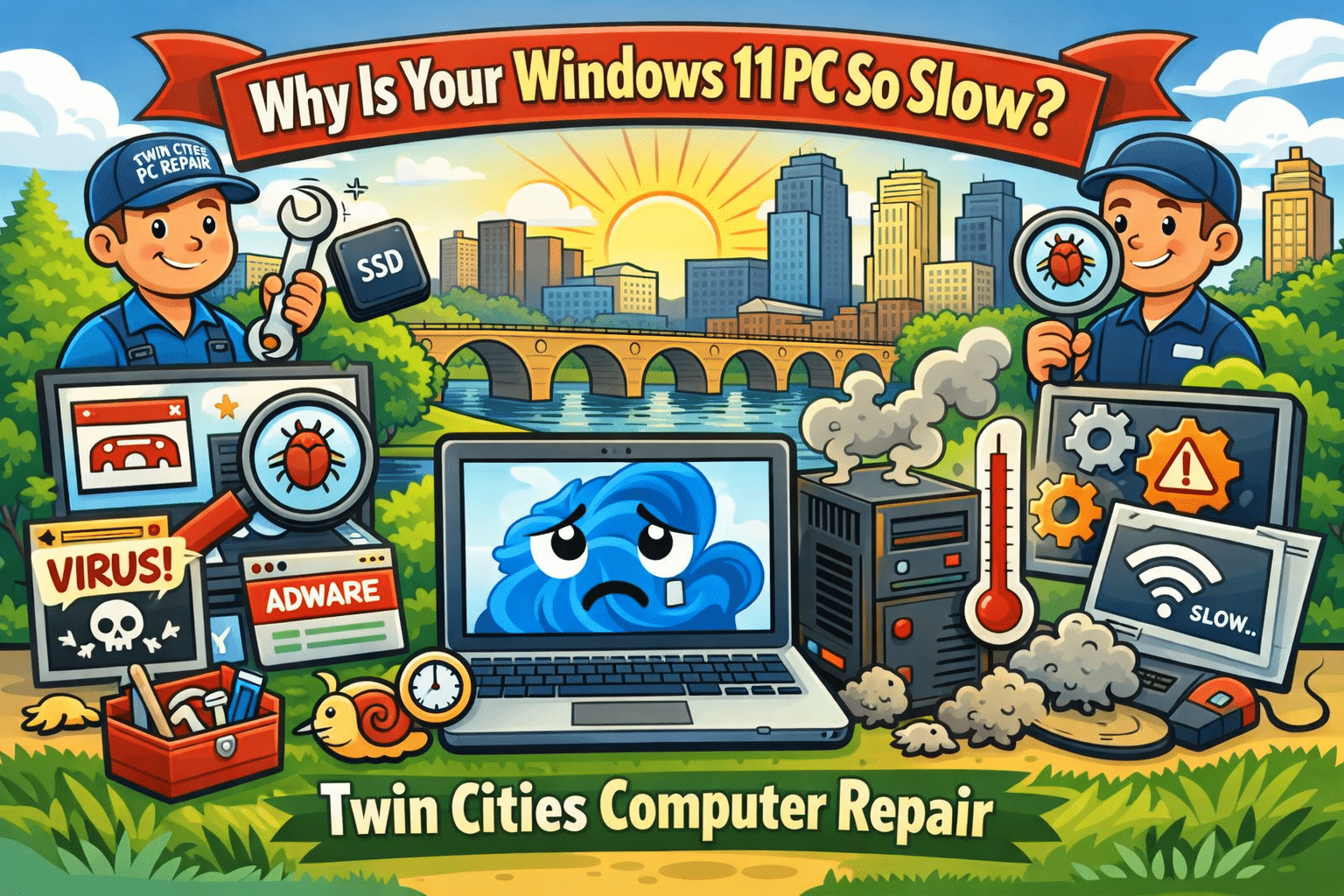
Why Windows 11 PCs Are Suddenly Running Slow (And What You Can Do About It) – 1/26/2026
If your computer has felt slower than usual lately, you’re not imagining it. Across the Twin Cities, we’ve been seeing a surge of customers bringing in Windows 11 desktops and laptops that were “fine last month” but now take forever to boot, lag during simple tasks, or freeze when opening programs. This is one of the hottest and most current computer repair issues right now because it affects everyday users, students, and small businesses alike—especially after recent updates and background security changes.
At Twin Cities PC Repair, we help customers in Bloomington, Richfield, Edina, Burnsville, Eden Prairie, and the greater Minneapolis–St. Paul area get their systems running fast again without losing important files.
Why Your Windows 11 PC Is Slowing Down Right Now
There are a few common causes we’re seeing repeatedly in local repair appointments:
1. Background Updates and “Silent” Maintenance
Windows 11 updates don’t just install once and disappear. Many updates trigger background tasks like indexing, system cleanup, security scans, and driver updates. On older PCs (or even newer ones with limited storage), this can cause random slowdowns, high CPU usage, and long boot times.
2. SSD Storage Filling Up
A PC with a 256GB or 500GB SSD can feel blazing fast—until it hits a storage wall. When your drive gets close to full, Windows struggles to manage temporary files, paging, and system processes. We commonly see machines with less than 10–15% free space, and that alone can make the system feel “broken.”
3. Startup Programs Taking Over
Many popular apps install auto-start services that run the second you turn on your PC. Some are helpful. Many are not. The result is a computer that takes 5–10 minutes to become usable after booting. This is extremely common with systems that have been used for a couple years without a tune-up.
4. Malware and Browser Hijackers (Still a Big Problem)
Even in 2026, malware hasn’t gone away—it’s just gotten sneakier. We’re seeing more cases of:
Fake “Microsoft support” pop-ups
Browser redirects and unwanted extensions
Credential-stealing spyware
Adware that slows everything down
These threats can make your PC crawl, even if you have antivirus installed.
5. Overheating and Dust Buildup
Minnesota weather swings are rough on electronics—especially if a PC is kept near a vent, heater, or dusty area. Over time, dust blocks airflow and your CPU overheats. When that happens, the computer “throttles” performance to prevent damage, causing lag and stuttering.
Quick Fixes You Can Try at Home (Before You Bring It In)
If your computer is still usable, try these steps:
Restart the PC (not shut down—restart forces updates and memory cleanup)
Check storage space and delete large files or uninstall unused apps
Run Windows Security scan and remove suspicious browser extensions
Update drivers (especially graphics + Wi-Fi)
Make sure your PC is ventilated and not clogged with dust
If these don’t help, it may be time for a professional diagnosis.
When It’s Time for a Repair Shop Instead of DIY
Some slowdowns are caused by deeper issues that require hands-on troubleshooting, such as:
A failing SSD or hard drive
Corrupted Windows system files
Bad RAM (random freezes and crashes)
Overheating requiring internal cleaning and new thermal paste
Virus infections that keep coming back
A proper computer tune-up can often restore performance without replacing the whole machine.
Local Computer Repair You Can Trust in the Twin Cities
If you’re tired of guessing, Twin Cities PC Repair can help. We specialize in:
Windows 11 performance tune-ups
Virus and malware removal
SSD upgrades and data transfers
Laptop and desktop diagnostics
Custom PC builds and upgrades
Whether you’re in Bloomington, Minneapolis, St. Paul, Edina, Richfield, Burnsville, or Eagan, we’re here to get your computer running fast again—without the big-box runaround.
If your PC is slow, freezing, or acting weird, don’t wait until it won’t boot at all. Getting it checked early can save your files and prevent bigger repair costs later.
Why Local Computer Repair Shops Still Matter More Than Big-Box Stores – 1/13/2026
In today’s world of mega-retailers, nationwide chains, and online tech giants, it can feel like small, locally owned computer repair shops are being pushed aside. But when it comes to something as personal and critical as your computer, your data, and your digital life, small businesses like Twin Cities PC Repair play a role that big-box stores simply cannot replace.
Your computer isn’t just a device—it holds family photos, tax records, work projects, emails, passwords, and sometimes even your entire business. Who you trust to touch it matters more than most people realize.
Big-Box Stores Treat Your Computer Like a Ticket Number
When you bring your PC or laptop into a big retail store, the process usually looks like this:
You drop it off at a counter
A ticket is created
Your computer goes into a back room
A technician you’ll never meet works on it
It may be sent offsite to another state
You get it back days or weeks later
You never speak directly to the person repairing your device. You can’t ask them questions. You can’t explain how you use your computer. You can’t describe the strange noise, random crash, or slow behavior in your own words. And when something doesn’t work right after the repair, you start the process all over again with a new person.
Big-box repair services are designed for volume, not relationships. Their goal is to process as many devices as possible as quickly as possible. That often leads to rushed diagnostics, unnecessary part replacements, and missed underlying issues.
Local Shops Build Relationships, Not Just Receipts
At Twin Cities PC Repair, you’re not just another number in a queue—you’re a real person with real technology needs. When you work with a local repair shop, you’re building a relationship with the technician who will likely work on your computer again in the future.
That means:
Your technician learns how you use your computer
They remember past issues and previous repairs
They understand what matters to you
They can spot patterns before they become disasters
If you work from home, game, do graphic design, manage finances, or just want a reliable family PC, your local technician can tailor solutions specifically to your lifestyle.
This personal knowledge saves you time, money, and frustration.
Trust Is Everything in Computer Repair
When you hand someone your computer, you are handing them access to your entire digital life. Photos of your kids. Banking info. Work documents. Saved passwords. Email. Browsing history. Business files.
Trust is not something you can get from a nationwide corporation. It is built over time through honest service, clear communication, and consistent results.
At Twin Cities PC Repair, our reputation is built on trust. We live here, serve our neighbors, and depend on word-of-mouth referrals from Bloomington, Richfield, Edina, Burnsville, and the surrounding Twin Cities communities. That means we do the job right the first time—because our business depends on your satisfaction.
We don’t push unnecessary upgrades or upsell things you don’t need. We explain what’s wrong, what it will cost, and why it matters.
Local Shops Are Faster and More Flexible
Big-box repair services often take weeks. Why? Because they are overloaded and understaffed. Your device may be shipped elsewhere. Your issue may be stuck in a backlog.
Local shops can often diagnose and repair issues the same day or within a few days. And if you have an urgent situation—like a broken laptop for work or a virus on your family PC—you can speak directly to the technician and get realistic timelines.
Need advice before buying a new computer? Want to build a custom PC? Have a question about upgrades? A local shop gives you straight answers without sales pressure.
Supporting Local Means Supporting Your Community
When you choose Twin Cities PC Repair, you are supporting:
A locally owned business
Local jobs
The Minnesota economy
Personalized service that big chains can’t offer
Instead of sending your money to a corporate headquarters in another state, you’re investing in a business that reinvests right here in the Twin Cities.
The Bottom Line
Big-box stores are built for mass-market convenience. Local computer repair shops are built for people.
If you want fast service, honest advice, real accountability, and a technician who actually knows you and your computer, Twin Cities PC Repair is here for you.
Your technology is too important to trust to a faceless system. Build a relationship. Build trust. And keep your digital life in good hands.
Why Your Computer Is Slowing Down (and How to Fix It Before It Gets Worse) – 11/24/2025
Whether you use your computer for running your business, online learning, gaming, or simply everyday browsing, one thing is universally frustrating: a slow, laggy machine. Over time, even powerful systems begin to lose their snap. In this week’s newsletter, we’re diving into one core topic that affects nearly every customer who walks through our doors:
The Hidden Reasons Your PC Slows Down — and What You Can Do About Each One
A slow computer rarely has a single cause. Instead, it’s usually a combination of software clutter, aging components, and missed maintenance. Here are the most common issues we diagnose every week at Twin Cities PC Repair.
1. Too Many Startup Programs
Most PCs have dozens of apps quietly running the moment you turn them on—slowing everything from boot time to basic performance. Many of these programs sneak in as “helpful assistants” but end up draining memory for no reason.
Fix: Disable unnecessary startup apps through Task Manager (Windows) or Login Items (Mac). Better fix: We can run a full startup optimization to remove bloat safely and cleanly.
2. Outdated or Failing Hardware
Hard drives wear out, RAM becomes insufficient, and older processors struggle with modern software demands. If your PC is 4+ years old, hardware may be a major contributor.
Fix: Upgrading to an SSD or adding more RAM often produces instant improvements. Best fix: Bring your device in for a hardware health check—we’ll test everything and recommend the most cost-effective upgrades.
3. Background Software You Don’t Even Know You Have
Hidden processes, unused apps, and even corrupted system services eat away at performance. This includes preinstalled “bloatware” and background update services.
Fix: Uninstall unused apps and run system cleanup tools. Safer fix: We perform full system tuning without risking critical OS files.
4. Fragmented or Corrupted Storage
Traditional hard drives (HDDs) slow dramatically as data becomes fragmented. Even SSDs can develop performance issues when near capacity.
Fix: Free up space, defragment HDDs, and run disk health checks. Professional fix: We scan drives for errors and optimize them safely—preventing data loss.
5. Malware & Unwanted Browser Extensions
This is more common than most people realize. Even “safe-looking” apps or extensions can track you, hijack browsing, or throttle performance.
Fix: Run a reputable antivirus scan and remove suspicious extensions. Best fix: Let us perform a deep malware scan—not just surface-level cleaning.
6. Skipped System Updates
Updates aren’t just for new features—they patch security holes and improve performance. Ignoring them can lead to instability and slowdowns.
Fix: Enable automatic updates for Windows, macOS, drivers, and apps (especially browsers!). Hands-off fix: We offer update management and routine tune-ups for businesses and home users.
Ready for a Faster, Healthier Computer?
A clean, optimized, malware-free system doesn’t just run better—it lasts longer and keeps your data safer. If your PC is starting to drag or you want to keep things running smoothly, book your drop-off appointment HERE.
We use cookies to ensure that we give you the best experience on our website. If you continue to use this site we will assume that you are happy with it.



Recent Comments